
- Home
- Products
- Sound Tech and PA
- Sound Tech Course
- Free Tech Resources
- Free Sound Tech Lessons
- Playing By Ear
- Play By Ear Course
- Ear Training & Music Theory Resources
- Worship Leading
- Worship Leading Course
- Free Worship Leader Training
- Free Worship Leader Resources
- Band Skills Course
- Free Worship Team Training
- Free Worship Team Resources
- Subscription
- Blog
- Contact
- About
- Search
Ask The Expert – T-Loop Feedback Whistles
Jon Foyle asked this question:
Our church has a t-loop and we often find that the guitar amps for the music band pick up
signals from the sound system that can lead to feedback whistles. We have tried placing the amps off the ground but it is unfortunate that the area that the band sets up seems to be very close to the t-loop path in the floor. Is there any way we can screen the amps from the t-loop signals? The only solution we have found so far is to turn off the amp mix to the t-loop circuit.

Tim Martin answers:
This is a great query as it’s an issue which affects a large number of churches. The first thing to say is that the problem is not actually with the amplifiers – it’s the guitars that pick up the signal from the t-loop (or induction loop) and it is then amplified along with the guitar sound (and any effects added to the sound).
A single coil guitar pickup is basically the same as the t-coil in a hearing aid so it is largely inevitable that this will happen if the guitar is within the range of an induction loop and facing in the right direction (you’ll probably notice that the feedback will disappear if you turn the guitar round 90 degrees).
The only way to get rid of the feedback with your current system is (as you have already found) to take the guitar sound out of the feed to the t-loop amplifier. The theory here is the same as feedback from microphones. If the sound from the original source comes back in via another root (i.e. speakers or the induction loop) the signal will be amplified before coming back into the pickups again and being amplified again and so on – this leads to the squealing and whistles.
The issue here is that you still have a problem even though the feedback has gone. The signal from the t-loop will still be fed through the guitar pickups and will be amplified (at a low level) through the amplifier along with any effects you use. This means that the sound of vocals and other instruments as well as spoken voices will be heard through the guitar amp (and then through the PA system if you mic or DI the signal). One possible way to solve this is to use the induction loop purely to amplify those who speak and need to be intelligible to those with hearing impairments. This does, however, deprive them of a full sound and may not be desirable in all situations.
One possible technical solution is to reverse the phase (ie wire the positive and negative sides of the lead the other way round) of the feed to the t-loop amplifier. This may allow the signals of the original guitar and the induction loop to phase cancel and therefore the result is no sound. This sometimes works, but not always!
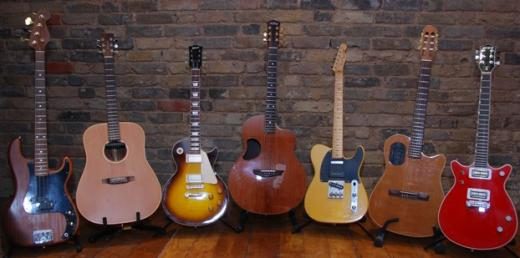
The best solutions are either to re-route the loop wire so that the guitars will be well outside it (at leads 10ft and maybe a little more) or to use a different guitar. Electric guitars with humbucker pickups (such as Les Paul’s) will not pick up the sound from an induction loop and this could be a solution which would work in your situation. If you don’t want to change guitars then you could consider modifying the ones you currently play.
I often encounter this problem with my Telecaster at my home church. Rather than buying a new guitar I plan on fitting noiseless pickups to my existing instrument in the hope that they will solve the problem. These are available both from Fender and some third party manufacturers and are ‘supposed’ to sound as good as standard single coil pickups (they are actually stacked humbuckers).
In conclusion, this is a problem which could affect anyone and the underlying issue is a poorly planned system. Although it is possible to overcome, it will almost always require either compromises or some degree of improvement to the installation of the t-loop. These systems are extremely important for the hearing impaired but should be planned around the needs of the church so that they can be both helpful and fit for purpose in their setting.
Tim Martin is the presenter of Musicademy’s Worship Keyboard DVDs but he’s also something of a PA expert too!
 My Favourite Guitars and a Recommendation for a Great New Buy Today from Fender
  How to get maximum exposure for your song writing
  8 ideas to encourage more participation in worship
  Streaming your worship services legally | Everything you need to know
  Streaming online church services: the tech, the tips and the stories from around the world
  What do you most struggle with as a worship musician?
  Worship Leader Training: Beginning and Ending Songs Well
  Learn how to play by ear
  4 tips for making good use of your mic

