musicademy outstanding practical worship tuition
Musicademy
The world's best instructional resources for the worshipper
Skip to content
  • Home
  • About
  • Store
  • Blog
  • Contact
  • Members Area
  • LOG IN
  • MY ACCOUNT
  • Learn more about Musicademy products

    • The Musicademy Portfolio
    • Playing By Ear
    • Guitar (Worship)
    • Guitar (Rock & Pop)
    • Bass
    • Keyboards
    • Drums
    • Orchestral Instruments
    • Singing
    • Singing (Harmony & BVs)
    • Worship Backing Tracks
    • The MultiTrack Player

    Questions? Check the FAQ

  • And other bits…

    • Affiliate Marketing with Musicademy
    • Teaching using our DVDs
    • Worship training days
    • Local courses
  • Latest Free Videos

    NEW Worship Backing Band MultiTrack Player with looping, jumping, key & tempo change

    Playing hymns on keyboard - How Great Thou Art - video lesson

    Worship guitar lesson - Substitute chords in C

    Worship bass lesson - In Christ Alone

    Free lesson - learn to sing the harmony part to Beautiful One


  • Free resources for church musicians

    New? Register with Musicademy to access free worship resources and sign up to our free worship magazine.


    Existing members Sign in here for the members area.

« Has worship music lost its soul?
Ask the Expert – How do you learn to sing and play lead guitar at the same time? »

Improving Your Projected Song Lyrics – Part 1
By Kenny Lamm | April 23, 2012

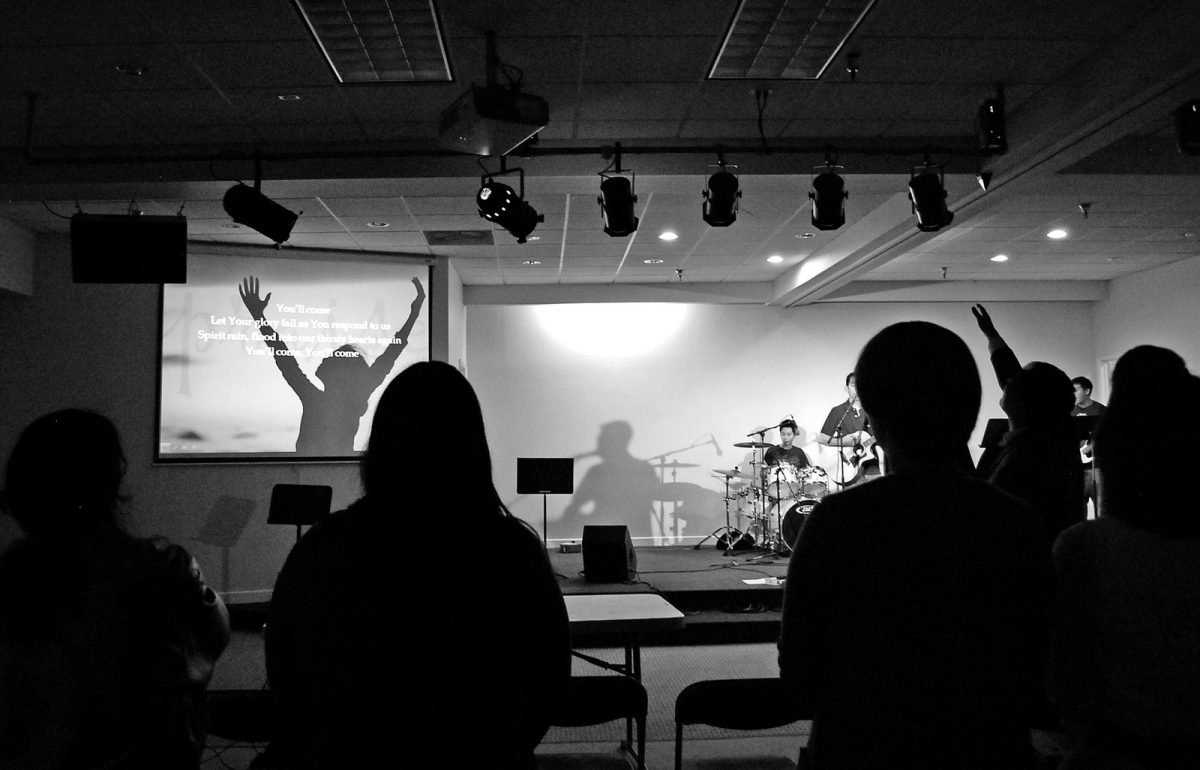
badpresentationDisplaying song lyrics in worship with excellence is an often overlooked area of preparation, yet one that can really enhance our worship times. Conversely, poor slide production and operation of the lyric display can greatly hamper worship. (If your church does not use video in worship, start with a previous post, Got Video?)

In the next few weeks, we will look at various components of slide production and operation. These principles will be applicable whether you use PowerPoint or one of the worship presentation software packages such as EasyWorship, MediaShout, ProPresenter, Open LP or SongShow Plus.

This post will address the font size, font type, and line spacing.

Our goal is to make the slide clearly readable by every person from the front row to the back row. Here are some things to keep in mind:

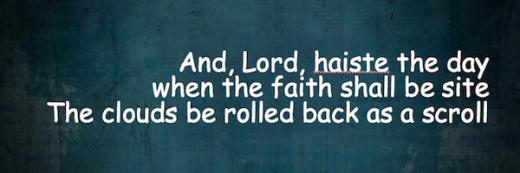
Select a sans-serif font. (that’s a font without “feet”). Some examples are Arial, Calibri, and Verdana. These fonts are easier to read than the serif fonts like Times Roman. Please please please NEVER use Comic Sans!

Here is an example of a serif font:

Now, look at the same slide with a sans-serif font. It is much cleaner and easier to read.

Don’t make the font size too large or too small; aim for just right. If your font size is too large, with little margins, it tends to create tension–almost a feeling of someone screaming at you.

However, small fonts will be unreadable to many, and they psychologically can lead to diminished singing. I see this most often when people try to include too many lyrics on one slide.

A good font size will have nice margins around the slide and the font will be somewhere in the 32-48 pt size, depending upon the font you are using. Some fonts are larger at 32 point than others. Here is an example of a good size:

The font size you select also should be dictated by the size of your screen and the longest distance from your screen to the places people stand for singing. If you have an under-sized screen for the room you are in, the fonts may have to be larger than optimal in order for the person farthest away to easily read the text. To determine this, try several font sizes on screen, standing at the farthest point and determine what is readable and what is too small. This will help you in determining font sizes for your presentations.

Aim for consistency in font size within the slides of a song. Avoid the temptation to size each slide separately for maximum font size within these guidelines. That can lead to some slides with much larger fonts than others, creating a sense of some being overbearing. Here is a poor example:

Note how much larger the last slide’s font is. By itself, it isn’t all bad, but in the context of the song, it is overbearing. It would be better to make the font exactly the same as the previous slides or only slightly larger:

Consider line spacing as you prepare the slide. In a later post, I will address the number of lines of text to include on a slide, but for now, let’s consider the spacing between lines. If your slide has only four lines of text, increase your line spacing to prevent the lines from looking crowded. The first slide has little space between lines. The second is much more pleasant to view:

The first example is too tight. The second one gives some breathing room. Putting in too much line spacing, however can be distracting as you move the lines too far apart:

I like to use around 1.2 – 1.3 for line spacing when possible.

Next, I will address many other qualities of good and bad lyric presentation. Take a good look at your slides for this weekend. Do you need to make some adjustments? I welcome your comments.

Kenny Lamm, senior consultant for worship and music for the Baptist State Convention of North Carolina, is a frequent worship conference leader with a strong focus on equipping leaders in North Carolina (USA) and Southeast Asia. His blog, Renewing Worship, features posts that explore ways to renew–impart new life and vigor to–the worship in the local church.

Other posts you might like:

What screen size does your church need for worship?

How bright a projector should be for different screen sizes.

7 reasons music techs are late with the words

Backgrounds behind song words – yes or no?

Moving images behind the words of worship songs – a help or hindrance?
Share this post: These icons link to social bookmarking sites where readers can share and discover new web pages.
  • Digg
  • del.icio.us
  • Facebook
  • Technorati
  • TwitThis
  • StumbleUpon
This entry was posted in Tech stuff. Bookmark the permalink. Trackbacks are closed, but you can post a comment.
  • http://www.engageworship.org Sam Hargreaves

    Hey Kenny – well done for tackling a ‘boring but important’ subject! Some really good tips here. I also like that your slides use proper punctuation – is that your usual practice? I’d be interested to see a post on that. Thanks.

  • Dan

    Regarding serif vs sans serif, are you sure about that? There are studies that show serif is easier to read in printed material, and that there is no discernible difference between the two for on screen use.

    Could you address text alignment? Personally I always align the text on the left and then centre the block on the screen. I think the eye finds it easier to scan back to the start of the line if the text is aligned on the left, though I’ve no idea if that’s actually true!

  • Ken Granger

    Kenny, excellent advice, and I, too, applaud you for using correct punctuation. I’m not sure why it is apparently ‘normal’ to just display words with no punctuation but I ALWAYS include punctuation. It’s just a thing with me, I guess, but I can’t stand seeing slides without it.

  • Ken Granger

    Regarding Dan’s comment on alignment, I’ve heard that as well (left-aligned being easier on the eyes) but it looks strange to me if text is aligned left but starting in the center of the screen. Of course it may still be easier to read but…

    With abstract backgrounds I tend to align lyrics to the center; if the background I’m using has an item that is the focus of the image, I’ll size the text box so that the text does not cover that portion of the image.

    With responsive readings I’ll align left as it helps recognize the ‘Leader’ and ‘All’ sections better.

    I have no real scientific basis for any of this; it’s just what looks best to me.

  • http://gracedover.com Jeff Rakes

    Font size in our presentation software program seems to be relative to projector screen resolution. Meaning 32-48 might be appropriate at 1024×768 but it might need to be different at 800×600 or 1600×1200.

  • Kirk Dickinson

    I agree with Jeff. I use ProPresenter and MediaShout both. It depends on which service I am doing. I find that a font size that works well in ProPresenter is not right for MediaShout, they measure the font size differently on the output. Also, it is very dependant on screen size. I usually do a Thursday Celebrate recovery on a 1024 x 768 screen and our CR band did the Saturday service one week. When I changed the output resolution to 1920 x 1080, I had to redo all the font sizes because they didn’t work at that resolution.

    My eyesight isn’t as good as it used to be, so what I do for a font size is guess at it, then put it up on the screen and go to the very back of the room, I bump it up until it is readable, then add 10-15% bigger to the font size. This should be readable for most people.

    I have found that there is no one good font size. You have to adjust for every song. And don’t rely on what you are seeing on the screen when you build the songs.

    I had a terrible incident where I did my entire presentation at home on my laptop for a special service at church. We set up a little differently than normal and when the first song kicked off, I realized that I hadn’t properly tested my lyrics on the screens at the venue. ALL MY FONTS WERE TOO SMALL TO READ! I was entering into major panic. I quickly built a template in ProPresenter and applied to all my presentations while presenting. I wouldn’t ever recommend this. Besides being stressful, you have problems keeping up with the slides. I had two college kids in media/music programs congratulate me for the nice presentation. I told them, give all the glory to God, because I felt like I had a train wreck going on the entire time.

  • nig

    Ouch- having to change point sizes? I use a package that specifies text size as a percentage of screen height [eg 7 or 8%] so no point size juggling required once worked out for a particular room. It also locks in margins so can do the ‘left justified to a bigger margin thang’ if required. The licence explicitly allows multiple installations, so anyone can load a playlist on their own laptop and know it will work at church through the projector
    I use left alignment as it does appear to suit more people.

    having said all that, there is still plenty of room for the talented time rich to create a wonderful visual experience with great images and text that is always readable and doesn’t crash- I look forward to the occasions when those are available.

  • Dannie

    I have been projecting songs on screens since the time of overheads. I know, I’m a dinosaur. These have been some of my “standards”:
    Minimum 32 font size, typically Arial (san-serif)
    Minimum amount of punctuation at the end of lines but logical punctuation in the lines.
    VERY fussy (another word came to mind, but decided against using it) about typos! I think it’s the 8th thing God hates.
    Never split lines of a song that are flowing together between slides.
    Do NOT let the end of lines “run on”. They are ended at logical places. You need to sing the song to know where to end a line. I can always tell when a non-singer creates the slides.
    Normally make the background darker and use white for the font.
    I like background graphics and found that moving graphics can be effective.
    Try to work with four lines per slide on average.
    Have typically centred lines, rather than left justified but I know what you’re saying about the aesthetics of the left justified lines.
    Hope these are helpful.

  • Pingback: Improving Your Projected Song Lyrics – Part 3 | Musicademy

  • Suggestions for You

    A salute to the average worship leader
    A salute to the average worship leader

    4 tips for making good use of your mic
    4 tips for making good use of your mic

  • Free resources – index

    All the blog's free resources
    Guitar
    Vocals
    Keyboards
    Drums
    Bass
    Orchestral instruments
    Worship
    Tech stuff

  • New blog posts by email

    Enter your email address:

  • Recent Comments

    • Josh on Percussion techniques on acoustic guitar
    • Julie on What would a professional “worship consultant” make of your worship services?
    • Nigel Wiggins on A salute to the average worship leader
    • Pj on A salute to the average worship leader
    • Mark CE on A salute to the average worship leader
  • Categories

    • 50+ practical tips
    • Administration
    • Ask the expert
    • Chords & strumming patterns
    • Free Worship Magazine
    • Free worship resources
      • Bass
      • Drums & percussion
      • Guitar
      • Keyboards
      • Orchestral instruments
      • Vocals
    • MusiComedy
    • Pick of the best – favourites
    • Song writing
    • Tech stuff
    • Visual worship & creativity
    • Worship
    • Worship leading
    • Worship theology

Copyright © 2008 Musicademy :: Musicademy Directory

  • Home
  • About
  • Store
  • Blog
  • Contact
  • Members Area