
- Home
- Products
- Sound Tech and PA
- Sound Tech Course
- Free Tech Resources
- Free Sound Tech Lessons
- Playing By Ear
- Play By Ear Course
- Ear Training & Music Theory Resources
- Worship Leading
- Worship Leading Course
- Free Worship Leader Training
- Free Worship Leader Resources
- Band Skills Course
- Free Worship Team Training
- Free Worship Team Resources
- Subscription
- Blog
- Contact
- About
- Search
Altering the fabric of the building to reduce echo and reverb inside a Church
Part three in our series of sound proofing challenges in church
This is part 3 of a series about sound proofing in church. Part one considered options for churches with zero budget, part 2 continued this theme by looking at the main “noise-makers” inside the building with a view to again reducing noise without finding huge budgets. This article looks at the how to alter the fabric of the building to improve sound proofing.
Advanced warning; this is a really big topic! I have only managed to explore some the information in this field and I am by no means an expert! We’re well and truly in the realm of acoustics here, and many people would describe this world as an art form.
So here’s the scenario: you’re sat in Church and you are trying to hear the preacher but the building is so echoey you can only just about make out every third word they say. Sound familiar?
This problem at its core does not have a simple answer, I’m afraid.
Well, maybe I should re-phrase that: the answers are straightforward, but the costs are generally high. There are some basic things that can be done to help, like putting up soft-furnishings such as drape. You could even use foam squares to reduce the echo, but ultimately more thought should go into this than just sticking something up and hoping it works.
If possible, I would suggest bringing in a consultant. They can take some readings and make suggestions based on the data collected to come up with a way of reducing the overwhelming diffuse energy. The type of acoustic treatment required will vary according to the specific frequency band you need to treat. Of course, it can be very expensive!
Some background on acoustics
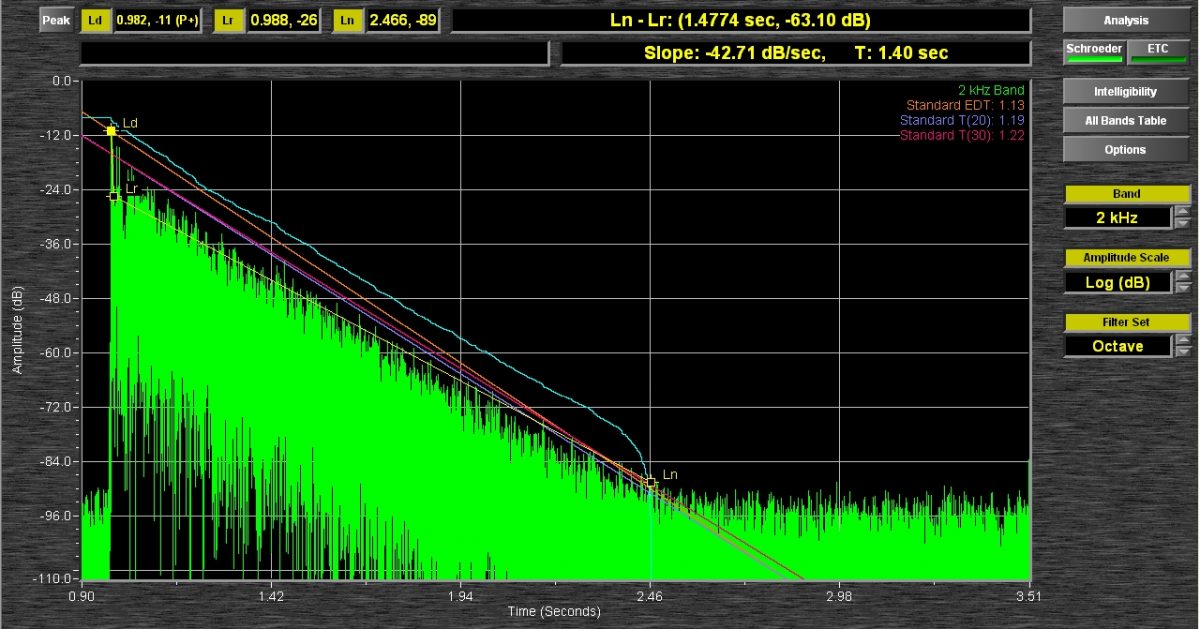
When we think about the diffuse energy in a building, we are interested in the RT, or Reverb Time. We measure RT in seconds; for example a school classroom would have a very low RT (0.5 seconds) whilst a Cathedral would have a very large RT (perhaps up to 7 seconds, or more). The most accurate way to measure the RT of a venue is by carrying out RT60 tests that record an impulse response (for example using a starter pistol). We would then look specifically at those frequencies that give us the intelligibility in speech: 500Hz, 1,000Hz, and 2,000Hz. We call this Tmf, or The Mid Frequency.
The BB93 regulations are an interesting reference. BB93 states that a general purpose teaching area should have a Tmf value of less than 0.6-secs. This is primarily aimed at classrooms and lecture halls, rather than Church buildings, but the principle remains: the lower the RT, the better the intelligibility of speech.
In a Church however, expressions of worship through music are also important; if the RT is too short, then people are not encouraged to join in the corporate worship through singing because the building can feel out of proportion (a big building should have more reverb).
At SFL, we’ve got some ballpark numbers that we work to for our installation projects. From our experience, we’ve found that 1.0-1.5 seconds RT is an appropriate level: it is low enough for speech intelligibility and high enough for musical participation. If a Church building has any more than this we would recommend the use of acoustic treatment.
Sound absorbers and sound diffusers
Generally speaking there are two types of acoustic treatment: those that absorb sound and those that diffuse it. An absorber product would act like a sponge and “soak up” the unwanted sound; whereas a diffuser is designed to reflect the sound in random directions. The size, type and positioning of any product is a function of the frequency band that needs treating (low, mid, or high).
What causes reverb?
Reverb is created by parallel surfaces; the sound will hit one wall and bounce back and forth. Of course, we have three planes: left to right, back to front, and top to bottom. If we can treat one of each of these planes then we are able to reduce the reverb.
A diffusing product is just designed to stop the “flutter” created by parallel surfaces, as it will reflect the sound somewhere else. Essentially a diffuser is a complex surface; this could be cylindrical tubes cut in half and attached to a wall, or even a piece of carpet that has been “rippled” along a wall (at head height for example): both a create a more complex surface thus reducing parallel surface reflection.
Yes, these are potentially simple solutions, but I would exercise caution before heading down the DIY route. If you can, get some input from a local acoustic consultant. The venue is the most critical part of the sound system so why not hold fire on that new microphone or loudspeaker and consider whether some form of acoustic treatment could be a better upgrade?
The speaker system
It’s important to note that all of these acoustic treatments are independent of the speaker system. Some actions can be implemented with the speaker system design to ensure that the sound is directed towards the people, not unnecessarily into the diffuse field, but really these “electro-acoustic” (speaker system) implementations only work when carried out in tandem with acoustic treatment. If you are in a position to do some work on the building acoustic and the speaker system, I would recommend seeking outside assistance from someone who really understands the acoustics, speaker system design and Church worship.
If you are interested; here is a link to a case-study of the project we did with Holy Trinity Brompton a few years back. The speaker system in the design is still in use and is identical to how we left it six years ago…
 My Favourite Guitars and a Recommendation for a Great New Buy Today from Fender
  How to get maximum exposure for your song writing
  8 ideas to encourage more participation in worship
  Streaming your worship services legally | Everything you need to know
  Streaming online church services: the tech, the tips and the stories from around the world
  What do you most struggle with as a worship musician?
  Worship Leader Training: Beginning and Ending Songs Well
  Learn how to play by ear
  4 tips for making good use of your mic

