
- Home
- Products
- Sound Tech and PA
- Sound Tech Course
- Free Tech Resources
- Free Sound Tech Lessons
- Playing By Ear
- Play By Ear Course
- Ear Training & Music Theory Resources
- Worship Leading
- Worship Leading Course
- Free Worship Leader Training
- Free Worship Leader Resources
- Band Skills Course
- Free Worship Team Training
- Free Worship Team Resources
- Subscription
- Blog
- Contact
- About
- Search
Practical tips and ideas for visual creativity in worship
What do you look at when worshiping? Do you watch the band or worship leader, stare at a large white screen with song words or mumble into a book? Maybe you know all the words and end up just looking at the back of the head of the person in front – unless, of course, your eyes are closed!
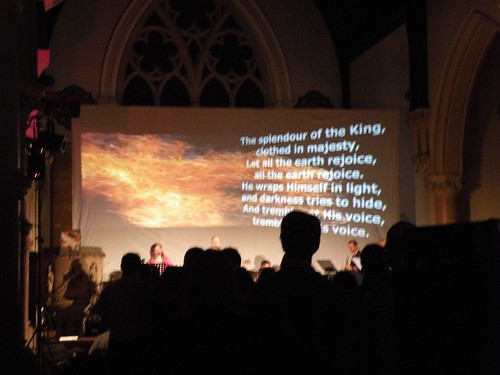 The integration of visuals with worship and church life continues a great tradition we have of using visual aids. Traditional church buildings are often visually rich places with stained glass, carvings, artwork, banners, flowers and architectural elements (often with forgotten meanings or symbology). As more churches invest in projectors and screens, it would be a pity if they only had song words on them and nothing with added visual interest.
The most obvious way of adding a visual element into a worship set is to use stills or video behind the song words and most presentation software will let you do this to some extent. However, what about taking this a step further?
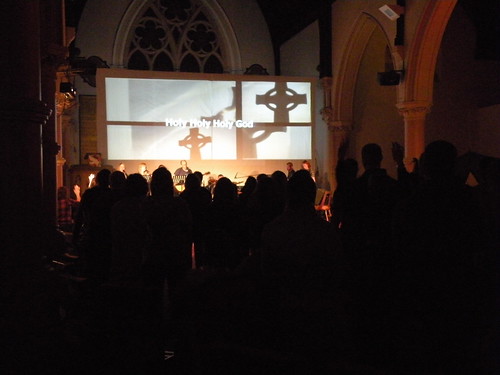
 Video can be mixed ‘live’ during the worship (i.e. unscripted from a collection of video clips) using VJing software or hardware. Visuals can be projected onto screens, walls, fabric, the roof or even organ pipes as well as where the song words happen to be. In this way visuals help to create an environment conducive to bringing people to worship not just a nice picture behind the song words. Here is an example from a Church of Scotland youth event…
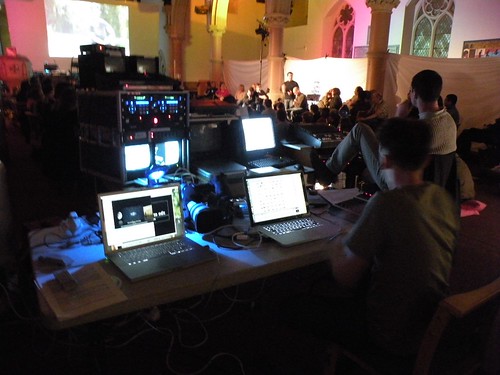
Now, before you run away in horror at the visual overload going on here, this example is towards the end of the event. At the start of the evening there was much less going on so as not to overwhelm people. Also, here we had eight projectors on multiple feeds, controlled by two operators as well as all the lighting so I’m not proposing this set up for a ‘normal’ weekly service but as an example of a visually rich worship environment.
To scale this right down in content and technology here’s another idea. Find some images that match the topic of the evening and put them onto acetate then use an old OHP to throw these pictures onto a wall during the service – it doesn’t matter what image is up when, how often you cycle through all the pictures you have, etc. you are only adding some visual interest to what is going on.
 |
 |
 |
I’ve been able to experiment with visual worship at my church and at various large events for over ten years now and a frequently asked question is “isn’t it distracting?” Well, I don’t think it is much more distracting than what the people around you are doing and in many cases it can help you to focus, especially for those who have a visual ‘learning style’. That said when talking about VJing during worship the footage and transitions are paced to fit the worship – this isn’t about using fast, flashy visuals that would fit in a club environment despite using technology and software developed for that.
The other problem people face is knowing how or when to mix the visuals, whether it is when to move to the next image or clip. Of course it can be worked out prior to the service or event, but I have learned that by leaving space to follow what ‘feels right’ often allows God to do the mixing – when visuals match other elements of the service which simply couldn’t be planned ahead of time. Here is a last video example where I try to explain that happening at our regular monthly Deeper service that uses lots of video:
For more information see Christian Visualist blog or DeepRiver.
– Graham Lynch
 My Favourite Guitars and a Recommendation for a Great New Buy Today from Fender
  How to get maximum exposure for your song writing
  8 ideas to encourage more participation in worship
  Streaming your worship services legally | Everything you need to know
  Streaming online church services: the tech, the tips and the stories from around the world
  What do you most struggle with as a worship musician?
  Worship Leader Training: Beginning and Ending Songs Well
  Learn how to play by ear
  4 tips for making good use of your mic

